
Symphony No. 4 in F Minor, Op. 36 (Mvmnt II) - Tchaikovsky
Personal Score: 7/10
Methodology
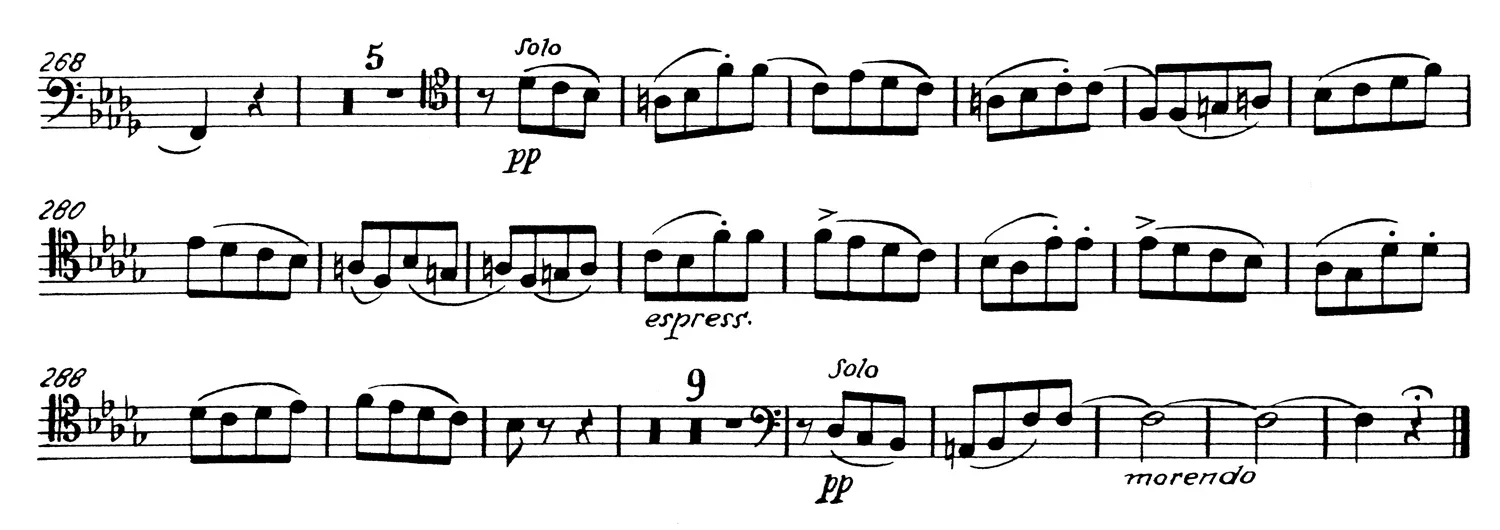
This excerpt is one of the better examples of being able to be expressive at soft dynamics. Because of the pizzicato string chords, this really is just a solo for one instrument. It’s important to note this from the score because it there is nothing to hide behind both technically and musically. However what makes this deceptively difficult is the key while staying at pianissimo.
On the flipside of not being able to hide and it just being one person, this allows for much more room for push and pull (with constraint). While the solo is alone, it still has to be reminiscent of the initial theme of this movement, which means that it has to still have a steady time. However with this being said, the ‘espress.’ is really going to be the start of when to push and pull — both because of the melodic shaping and the orchestration.
The most important thing to pay attention to is the dynamics. This is at the very end of the piece and everything is subdued in the score, so there’s nothing to cover the bassoon sound, but if the ‘pp’ is ignored (or grows too much), it can ruin the environment of the sound and break the immersion for the listener. Next thing to pay attention to, which contradicts the prior idea, is the shaping. Personally, I think this is the hardest part of the excerpt mainly because the player needs to have an overall musical shape while also basically being as quiet as possible AND projecting to an entire hall. So it becomes a delicate balance on a very fine line of being loud enough to be heard, but soft enough to sound like a thought. Last thing that also is an issue is staying lyrical the entire time. Because of the key, there are so many awkward intervals that will have tiny sound blips between. And because of this mixed with everything else, this excerpt is probably the most deceptively hard that is usually asked in auditions.
One thing that helps with all these issues (and more) is to play parallel passages identically. For example, mm. 284 and 286 follow the same pattern of a descending scale down. Even though they start on different notes, they should sound similar (shape wise) to keep things consistent across the excerpt. Likewise, mm. 275 and 277 have different notes, but follow a similar shape and should be reminiscent of each other.
What to focus on:
Dynamics
Shaping
Connectivity
For Next Time
Listening back on the recording, there are a couple of really nitpicky things that I need to go back to for cleaning up. Here’s what I heard:
Unfortunately, when I was taking the recording, the AC had just turned on which kind of messed with the recording quality.
Sometimes in the larger intervals, it kind of sounds like I’m “slingshotting” the 2nd note and makes it sound not smooth. I’m exaggerating this when I say it, but it also sounds very “wahwah” and disconnected. It should have more of a follow through in the overall structure of the line. Also in the staccatos, they should sound more similar to each other; same releases, lengths, and weight.
m282 - Starting the melody over, I can take a little more time since nothing is there in the background which will hopefully give me enough time to make it sound like the start of the excerpt, but more impactful.
m285 - What a terrible interval. I should find alternate fingerings to make it sound smoother cause it just sounds like there’s a lot of resistance that then leads to a tense sound that becomes out of tune.
Also in general, anytime there’s an F, it just pops out of the texture too much. Might try to find a slur fingering from Eb to F, or find a better finger leading.
Lastly, the final F I need to make more stable though a better fingering or more support because the last portion of the held note can get a little shaky.
(Might also test a reed thats a tiny bit harder when I get back to this)